Internal Referrals: The Crushing Reason for Lack of Creativity in India’s IT Sector
Editor: Chandan M
Published on: Dec. 17, 2025, 6:26 p.m.
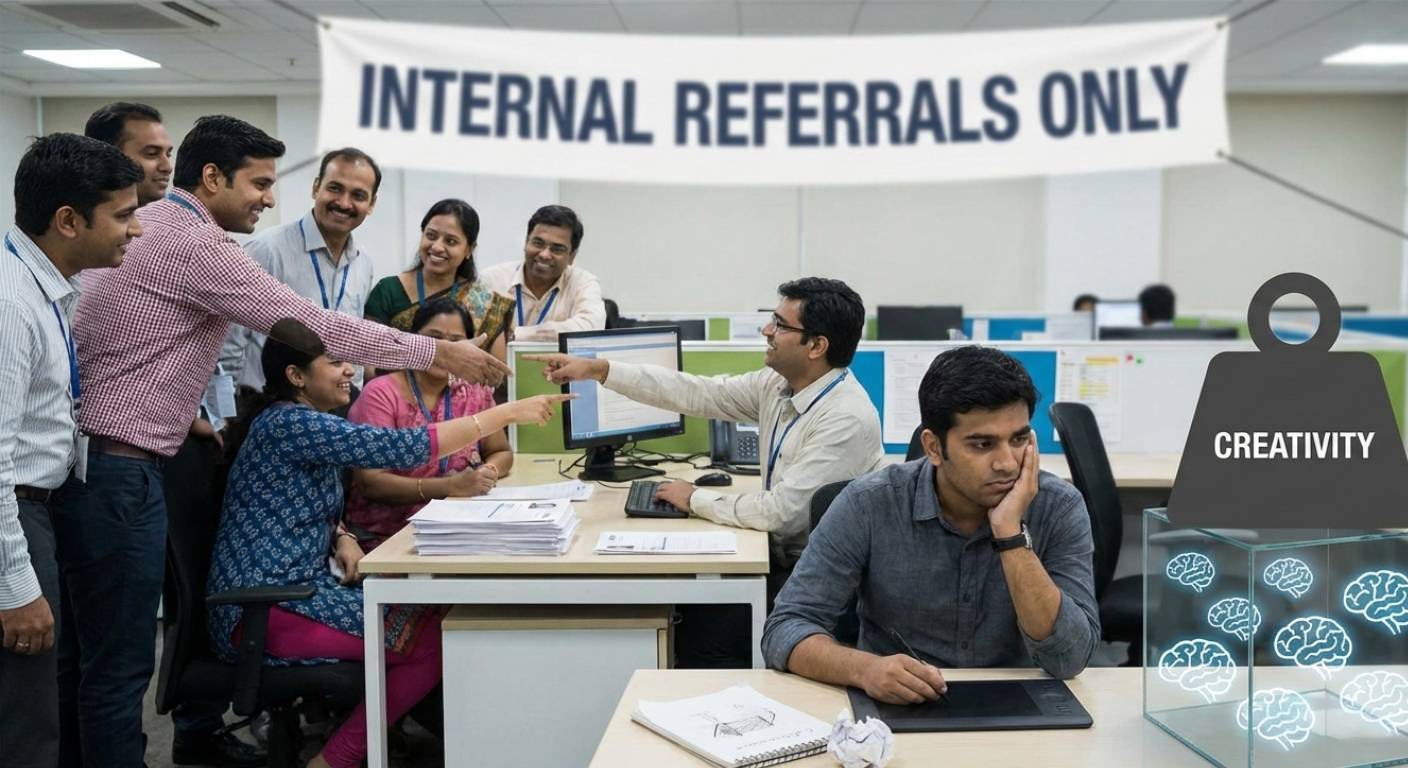
Bengaluru — India’s IT sector, long celebrated as a global powerhouse for software services and technical talent, is increasingly facing criticism for a perceived decline in creativity, innovation, and original thinking. Industry experts and professionals point to one growing practice as a key contributor: over-reliance on internal referrals in hiring. While employee referrals were originally designed to improve trust and reduce hiring time, critics argue that the system has evolved into a closed loop, prioritizing familiarity over fresh perspectives. As a result, many skilled candidates without internal networks struggle to enter top firms, regardless of merit. Hiring Speed Over Innovation Internal referrals often fast-track candidates through recruitment pipelines, sometimes bypassing rigorous evaluation processes. HR professionals admit this helps meet aggressive hiring targets but may unintentionally filter out unconventional thinkers, innovators, and diverse problem-solvers. “Innovation thrives on diversity of thought,” said a senior tech recruiter. “When teams are built from the same colleges, backgrounds, and social circles, creativity naturally suffers.” Homogeneity in Teams Analysts note that referral-heavy hiring leads to homogeneous work cultures, where employees share similar skill sets, ideologies, and risk-averse mindsets. This environment discourages experimentation and challenges to existing systems—key ingredients for innovation. Several engineers claim this has turned many IT roles into execution-driven jobs, focused on delivery rather than invention. Impact on Young and Independent Talent Fresh graduates, self-taught developers, and candidates from non-elite institutions say they face systemic disadvantages. Despite strong portfolios or open-source contributions, many are overlooked due to lack of internal connections. “This creates a perception that talent alone is not enough,” said a freelance software developer. “Who you know matters more than what you can build.” Creativity vs Comfort Hiring Industry observers warn that comfort hiring—choosing candidates who “fit in easily”—may provide short-term efficiency but long-term stagnation. Global tech leaders emphasize that breakthrough innovation often comes from outsiders who question established norms. What Needs to Change Experts suggest companies rebalance hiring strategies by: Strengthening blind skill-based assessments Valuing project portfolios and problem-solving ability Limiting referral quotas per hiring cycle Encouraging diversity in educational and professional backgrounds The Bigger Picture As global tech moves toward AI, deep tech, and original product development, India’s IT sector risks falling behind if it continues to prioritize network-driven hiring over raw talent and creativity. The debate has sparked wider conversations on social media and within tech communities, raising a crucial question: Can India remain an innovation leader without rethinking how it hires?